
Tesla's copper egg
Upstraightening the spinning egg
At the World Fair in Chicago, on May 1, 1893, on the occasion of the 400th anniversary of Columbus's discovery of America, Tesla humorously demonstrated a rotating magnetic field. He connected the copper egg and the appropriate legend of Columbus's egg.
The copper egg in the shallow wooden bowl starts spinning like the rotor of an induction electric motor. Because of eddy currents in the copper, this egg-shaped rotor follows the rotating magnetic field of the two phases of the surrounding coils and straightens up as it rotates. Straightening up does not, however, occur as a result of electromagnetic impact. The egg is straightened up only by mechanical forces similar to those that act on spinning tops. The frictional force between the egg and the table accounts for the basic mechanism. If this friction force does not exist, or if the egg rolls without slipping, the ellipsoid will continue to rotate freely without straightening.
Tesla's spinning magnetic field is just the driving force behind the copper rotor's revolution, and egg was straightened as a result of a well-known phenomena that occurs when a hen's egg on a flat surface stand upright during sufficiently fast rotation. In his childhood, Tesla witnessed how an egg was turned manually to assess whether it was cooked or raw. The cooked one would spin and stand up, whereas the raw one would slow down. A raw egg cannot raise its center of gravity because the angular velocity of the shell must be transferred to the fluid interior. As a result, the majority of the original kinetic energy is lost, and the residual energy is insufficient for the egg to achieve gyroscopic equilibrium.
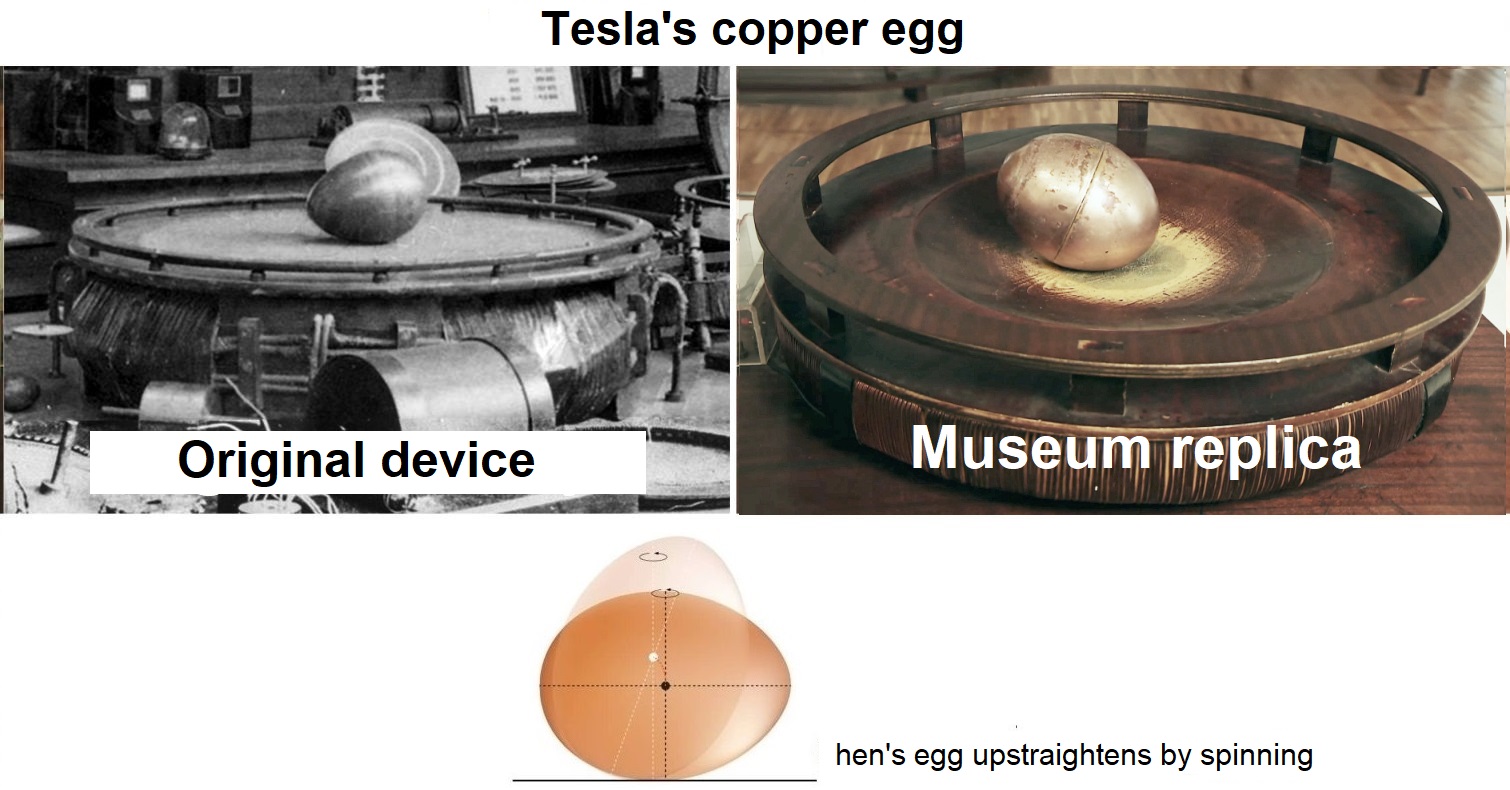
A detailed description of the production of the model-replica of Tesla's Columbus egg, which was designed and made by Zvonimir Rudomino, can be found on the website of the company "RT17 d.o.o." TESLA’S EGG OF COLUMBUS REPLICA.