
Centripetal acceleration
Proportional or inversely proportional to radius
It is undeniable that the material of circular motion in the first grades of high school is more difficult for students compared to rectilinear motion and there is some relief for students after they "get out" of this material. I tried to answer why this is so. The micro-methodology of teaching physics that deals with details in teaching reveals several conceptual difficulties that make this material "difficult"? In general, circular motion is not intuitive, so ways of interpretation are suggested that facilitate the acquisition of this material. It is also a fact that in this part of the material there is a conceptually new mathematical apparatus that should be gradually introduced.
In textbooks, as an illustration of centripetal acceleration (and force), photos of a carousel from a Luna park are usually included. On that device, the acceleration is greater if we are further from the center of rotation. And then the text provides a formula of inverse proportionality with the radius, which says that the acceleration is greater if we are closer to the center. The problem is that angular velocity is not yet introduced in the 1st grade, but only in the 3rd when describing vibrations. To get to the concept of angular velocity, one must gradually master the concept of a circle, the length (extent) of a circular path, explain the number π, introduce the concept of period, i.e. the time of one round of a circle, learn what peripheral or tangential velocity is, introduce a new measure of angle - radians, and only then learn what angular velocity is.
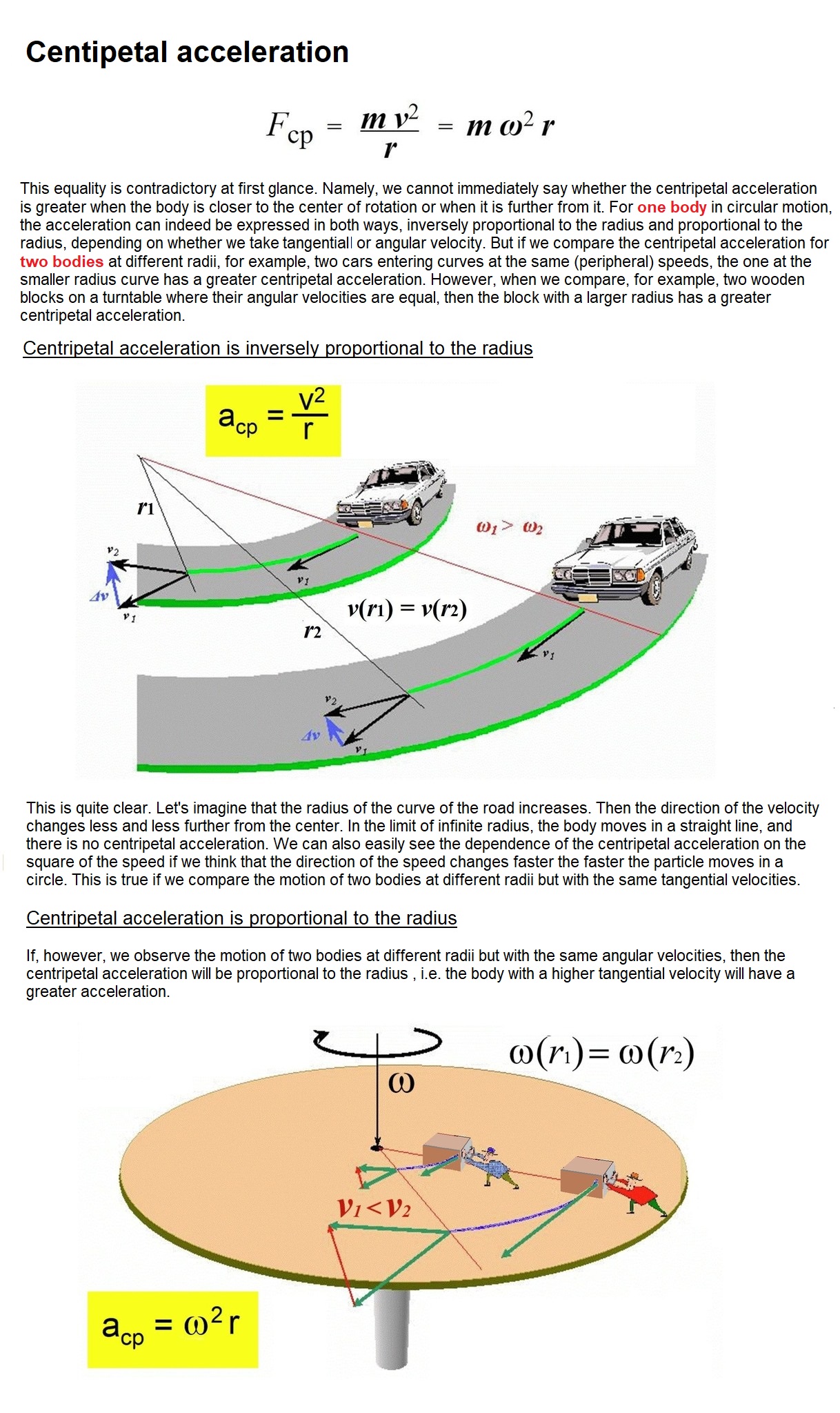
For an observer in a stationary system, centrifugal acceleration and centrifugal force do not exist. The truth is that centrifugal and centripetal forces are of the same amount and opposite directions and act on the same object but in different systems, so they are not subject to Newton's 1st law and do not cancel each other out. If we were to claim that the centripetal and centrifugal forces cancel each other out, it would mean that the total force on the object is zero, so according to Newton's 1st law, the object should be at rest or moving in a straight line, but it does not because it is rotating.

Centripetal force is greater at shorter radius
Each experiment performed on the turntable, shows that the centripetal force is greater at a larger radius (F ~ r) and then the students encounter a formula in the textbooks that tells them the opposite (F ~ 1/r).

The solution to this confusion is this lab. The following experiment should be performed to demonstrate the inverse proportionality of the centripetal force and the radius:

The popular self-service shopping cart is loaded with weight of about 60 kg. The path indicated on the floor must be followed when pushing the cart. Pay close attention to the section of the course where we must change our velocity direction, i.e. go into a circular motion.
It will be interesting (and fun) when students change the mass in the cart, the speed at which they try to turn the corner and the radius of the path.
When turning a cart with caster wheels that can spin in any direction, what can we see?
Since there is little rolling friction with this cart, the centripetal force cannot be the force of friction. For this reason, when making a turn, an extra force should be provided in the direction of the track's centre of curvature.
CHANGE THE PARAMETERS ON WHICH THE CENTRIPETAL FORCE DEPENDS: WHAT CAN WE CHANGE?