
Basic mechannics
Aristotelian thinking and Newtonian concepts
Newton's laws represent concepts that are hard to comprehend material. It is reasonable to ask: If more than 2000 years had to pass from Aristotle (350 BC) to Newton (1670), how students could possibly learn these ideas in two or three school hours. Undoubtedly, ”naturalness” and intuitiveness of the Aristotelian way of thinking according to which "an object is at rest if no force acts on it, and it moves only if a force acts on it" contribute to its difficult adoption.
This deeply ingrained causality, which incorrectly links motion to force and rest to the absence of force, necessitates a unique teaching strategy.
The experiment that follows is one method.
On a horizontal table with very little friction, a cart is set up. A weight is suspended at the end of the thread that is tied to cart, and it is passed over the pulley on the table's edge. The peculiarity of the experiment is that the weight can only be lowered to a height of h. As a result, the cart can operate in two modes: first, when the weight descends, the cart is subject to the force of thread tension. And secondly, when weight comes to rest on the support C the force that was accelerating the system ceases, and no force acts on the cart anymore. (See Figure)
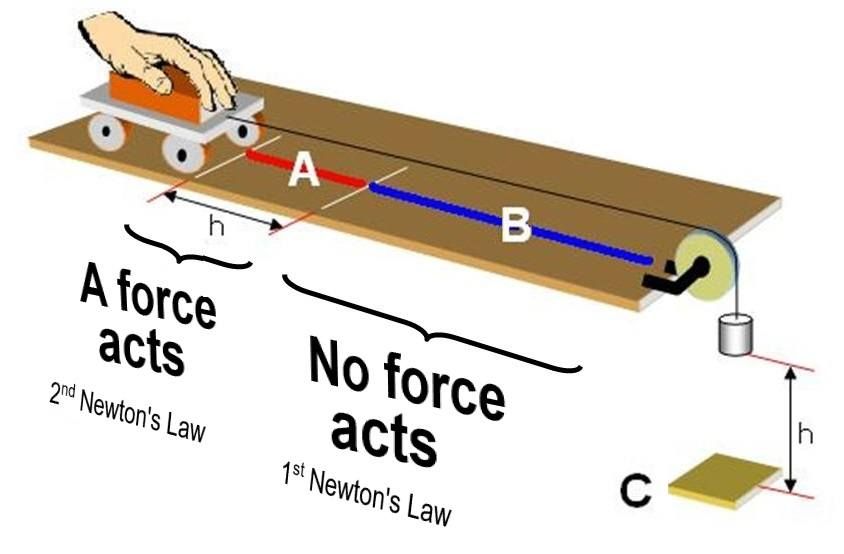
Image Weight descending constrained to the height h. This allows us to find the cart in two modes; the first, while the weight descends the cart is subject to the force of thread tension, and the second, when the weight stops on the base, the effect of the accelerating force ceases and no force acts on the trolley.
We measured the length equal to the height h as section A. If we let the cart go wherever on section A it starts to move. So we can conclude that the moving is cosed by a force. Typically, students will state that the cart starts moving because a force is acting on it. The cart is at rest wherever it is placed on section B because the weight is on the support C and the thread is not tensioned. Again, students typically declare that the cart is at rest because there is no force acting on it. These are preconceptions.
If we now release the cart from the initial position, the weight descends through the entire height h, so the cart at section A (which is equal to the height h) will be under the action of the constant force of thread tension, and this force will accelerate it.As soon as the weight sits on the solid support C, the thread tension force disappears. The conceptual question is: Will the cart come to a stop at that precise moment since the force that propelled it forward is no longer acting on it? And why, if not? If the students forecast that the cart will keep moving in section B, then this contradicts the statement that the object is at rest when no force acts on it! What is the cart's speed once it enters section B is another question we can pose.
Our intuitive idea is that motion is related to the act of pushing, lifting or pulling. After repeated experience, we would confidently claim that we have to push harder if we want the object to move faster. It seems natural to conclude that the stronger the action on the object, the greater will be its speed. A cart pulled by four horses goes faster than a cart pulled by only two horses. Intuition therefore tells us that motion is intrinsically linked to the action of force. However, the way of thinking guided by intuition is wrong and leads to wrong ideas about motion that persisted for two thousand years from Aristotle to Newton. It is still found in textbooks and other physics-related materials:
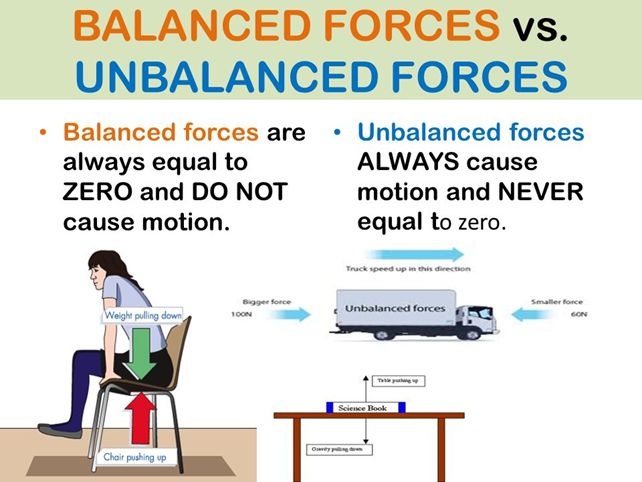
Image The claim that balanced forces do not cause motion implies the incorrect belief that motion is impossible if the sum of all forces equals zero.
